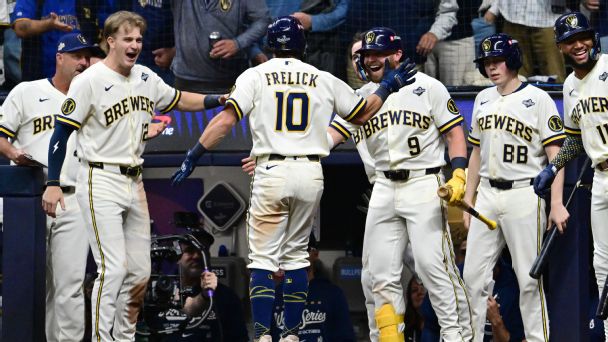
World Series Game 2 comeback shows Brewers are inevitable
By Jorge Perez· Founder, V12 DFS
This is context, not an automatic lineup change. It becomes actionable only when it connects to the slate, price, ownership, or confirmed role.
The Brewers' Game 2 comeback is the kind of momentum narrative that shifts ownership patterns on DFS slates. When a team demonstrates late-inning resilience in a World Series setting, public perception hardens around them—and that means their hitters climb in projected ownership faster than their fundamental matchup quality alone would justify. For DFS purposes, this translates to a critical split: chalky Brewers bats that the optimizer flags as popular, versus a contrarian fade if the opposing pitcher's underlying metrics (strikeout rate, walk rate, opposing team's K%) actually favor game script isolation rather than a team destined for comebacks. The narrative is real, but it's not the same thing as a projection edge.
Game 2 comebacks create blowout-risk exposure that slate optimizers treat differently depending on game total and rest. If the World Series carries a 9+ run implied total in Game 3 or beyond, the Brewers lineup gets owned two ways: first, as the narrative "can't be stopped" team, and second, as the heavy-favorite underdog bias (if they're favored). That concentration risk cuts both ways. The late-inning offensive sequencing that wins a single game doesn't guarantee plate discipline or power upside in the next one—especially after a high-adrenaline effort. V12's MLB DFS optimizer weighs recency bias against true matchup advantage, flagging when a team's previous result has inflated ownership beyond what the pitching, ballpark, and weather conditions warrant for the upcoming slate.
For cash and GPP players, the play is straightforward: lock your Brewers exposure early against weak ownership, or pivot to their opposing pitcher's inducing skills (if the matchup favors ground balls or strikeouts) and chase contrarian leverage. If public ownership on Brewers bats spikes post-Game 2, their ceiling games become less valuable in GPPs and more valuable in cash (where you're playing for median and not outlier upside). Verify the pitching matchup, check implied totals, and resist the urge to add salary relief just to fit "inevitability" into your construction.
Turn this MLB news into a lineup tonight
V12's MLB engine reads slate context, builds a candidate pool, runs configured simulations, ranks the portfolio with ownership and behavioral pattern signals, and ships a FanDuel-ready CSV. The news above becomes one input among many — not a forced lineup change.