Yahoo Fantasy Baseball: A 101 guide on how to play
By Jorge Perez· Founder, V12 DFS
Beginner education matters for SEO and retention. This piece is useful for explaining rules, roster decisions, and how fantasy sports strategy connects to DFS thinking.
Daily Fantasy Baseball Is a Different Beast Than Season-Long Leagues
The headline focuses on season-long fantasy baseball, but daily fantasy baseball operates on an entirely different set of mechanics. Where traditional fantasy leagues ask you to draft 23 players and manage a roster across six months, DFS slates consolidate the entire strategic challenge into a single day or week. A DFS player builds a salary-capped lineup against a fixed opponent pool, locks in, and either cashes or doesn't—no waiver claims, no trade deadlines, no second-guessing in July. For anyone coming from a season-long background, DFS feels like distilled baseball strategy: you're not managing a season arc; you're solving a one-day optimization problem that hinges on pitching matchups, weather, park factors, and ownership leverage.
The optimizer is your co-pilot in this environment. While season-long leagues reward player knowledge and patience, DFS rewards the ability to synthesize live data—Vegas totals, lineup cards, sharp money, ownership breakdowns—and translate it into a competitive roster before lock. A pitcher facing a depleted lineup in a 7-run game total, or a lead-off hitter in a stack against a weak opposing arm, presents a ceiling-floor calculation that changes minute-to-minute. Your DFS slate exposure, your pivot off chalk, your contrarian play in a GPP—these are levers you pull in real time, not draft picks you set and forget. The FanDuel CSV export and your optimizer's leverage signals become the language you speak, not just waiver-wire rumors.
Season-long players often gravitate to DFS because the game rewards sharp input and fast execution. If you already understand batting order construction, pitcher-catcher chemistry, and how weather impacts fly-ball rates, you've got a foundation. The DFS read just narrows the scope: instead of projecting a 162-game season, you're identifying which slate cards offer the highest expected value against the contest field. Before you lock any lineup, cross-check your ownership assumptions—verify your stack logic against the game total, confirm your fade against the opposing pitcher's splits, and watch for late-swap confirmation as news breaks. That discipline, applied to a single day, is where DFS edge lives.
Turn this MLB news into a lineup tonight
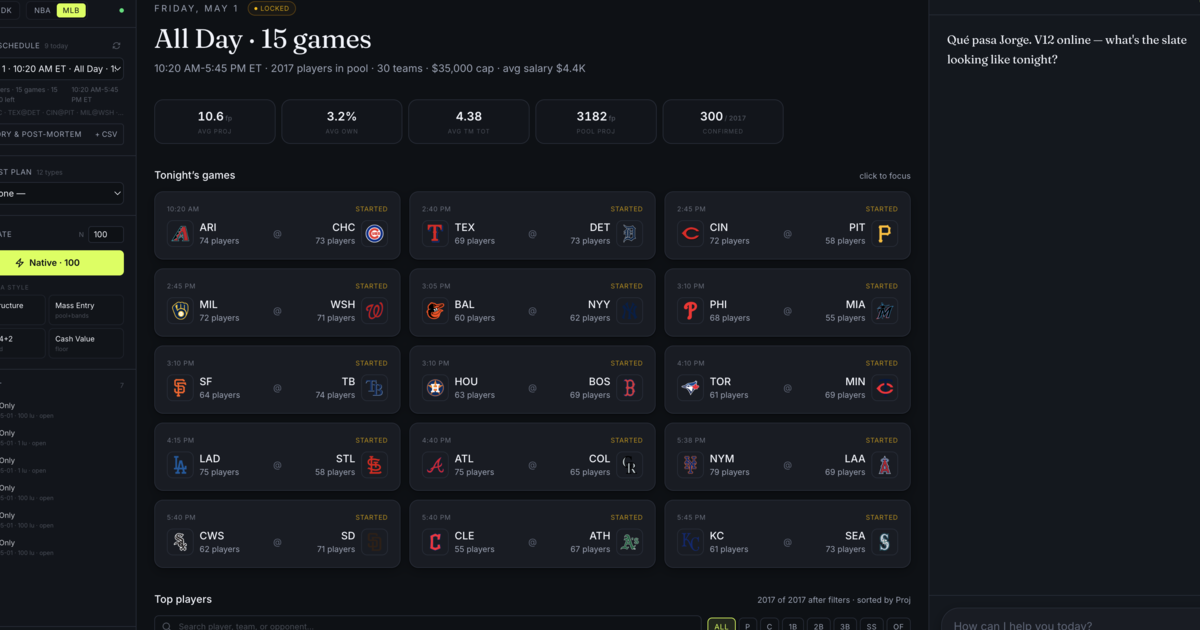
V12's MLB engine reads slate context, builds a candidate pool, runs configured simulations, ranks the portfolio with ownership and behavioral pattern signals, and ships a FanDuel-ready CSV. The news above becomes one input among many — not a forced lineup change.